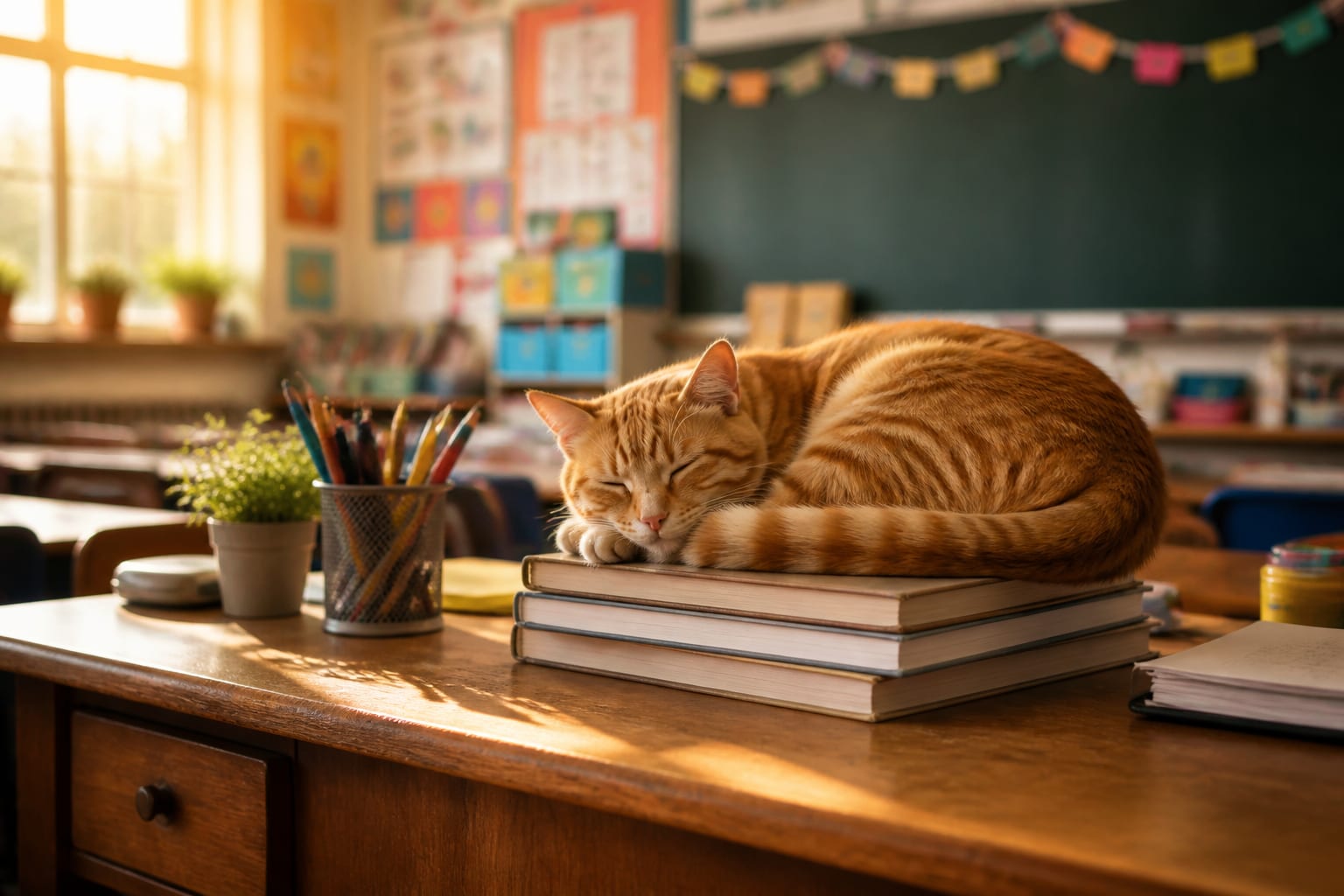
The door to Room 12 at Halverson Elementary was propped open on a warm Thursday in April because the building's air handling is older than most of its teachers. Sometime between the morning bell and the reading block, an orange-and-white cat walked in, crossed the room, and got onto the carpet where the students sit.
He has been at the school, in one official capacity or another, ever since.
"My first thought was liability," said Deirdre Vance, who has taught third grade at Halverson for sixteen years. "My second thought was that eleven eight-year-olds had gone completely silent for the first time all year, which almost never happens."
Vance did the sequence correctly, and it's worth spelling out because the impulse is usually to skip straight to the end. She contained the cat in a cardboard box with the lid open in the corner of the room, called the office, and called the county shelter. The cat was scanned for a microchip — none — and photographed, and his picture went on the shelter's found-pet board, the district's parent newsletter, and three neighborhood groups. State law required a hold period before he could be considered unowned. Nobody claimed him.
What happened next required more paperwork than the cat did. A district facilities policy prohibited animals in instructional spaces except for service animals and approved programs. The approved-program clause is what made it possible: with a signed veterinary health certificate, a written care plan, an allergy survey of all families in the class, an opt-out provision, and a designated staff handler, a classroom animal can be authorized.
All twenty-two families were surveyed. Two students had documented cat allergies. Both families opted to participate anyway after the school agreed to a set of accommodations: the cat is excluded from the carpet area during allergy season, the room gets a HEPA filter, and there's a hard rule that no student touches him without washing hands afterward.
He was neutered, vaccinated, treated for ear mites and a heavy flea burden, and tested for feline leukemia and FIV — both negative — at a cost of just under four hundred dollars, covered by a fundraiser that took the school's parent association nine hours to fill. He weighed six pounds and nine ounces at intake and now weighs nine pounds two.
The students named him Chapter. He has a bed on a shelf above the reading corner, a litter box in a staff closet, and a laminated schedule.
The part Vance did not anticipate is the reading. Halverson runs a program where struggling readers read aloud to a listener, and there is a real and reasonably well-supported literature on animal-assisted reading: children reading to a dog or cat show reduced anxiety markers and, in several studies, better fluency gains than children reading to an adult, largely because the animal does not correct them.
"I have a student who would not read out loud in September," Vance said. "Not quietly, not to me, not at all. He reads to that cat for fifteen minutes twice a week. I have data on his fluency and I'm not going to pretend I know exactly which variable did it. But he reads out loud now."
Chapter is legally owned by Vance, not the school, which is the standard arrangement and the one animal welfare groups recommend — it means he has one accountable person, a home to go to over the summer, and somewhere to be if the policy ever changes. He spent July at her house. He came back in August, according to her, in a bad mood.