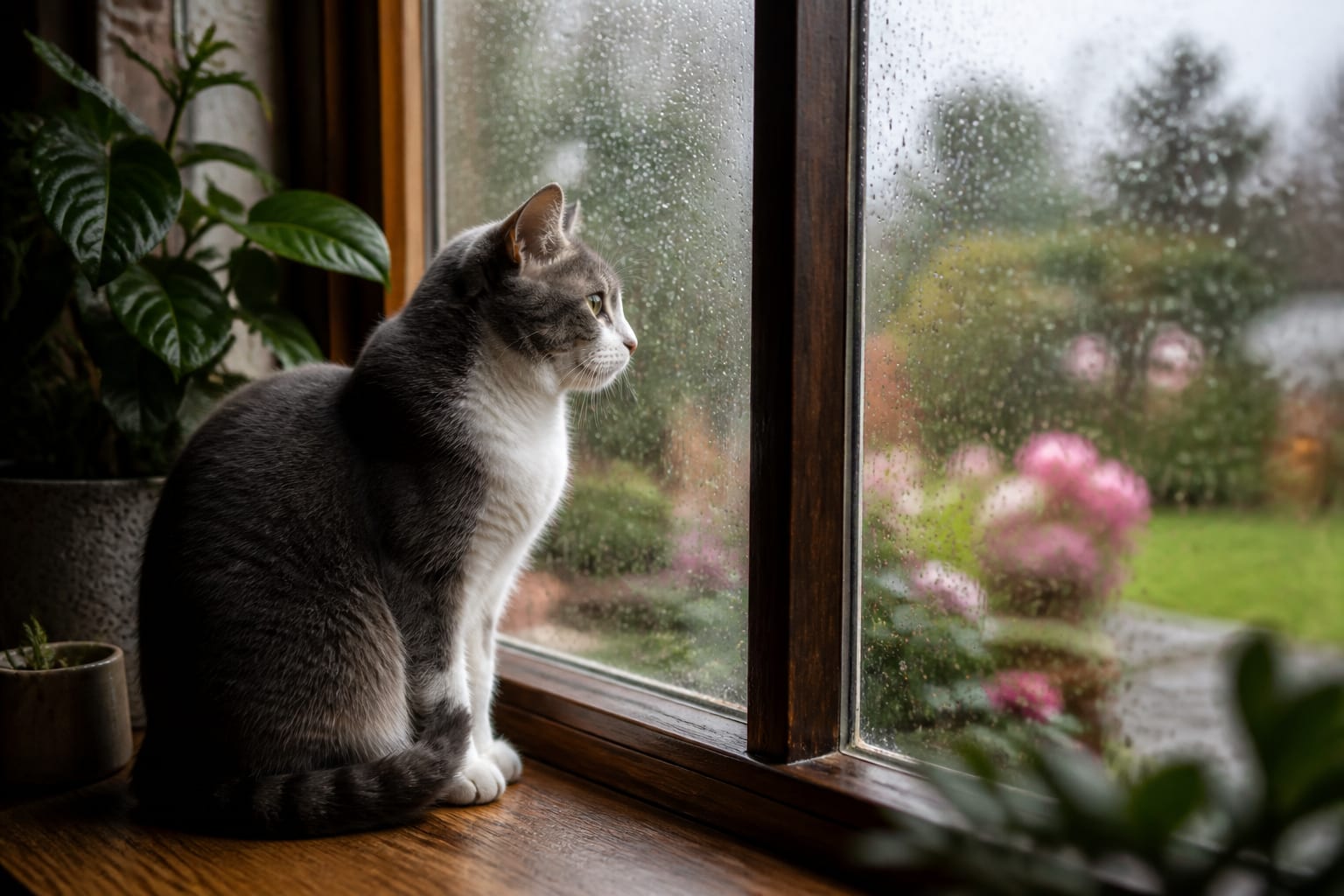
The cat in the window is such a fixture of domestic life that most owners never think to ask what he's getting out of it. The honest answer is: a great deal, and most of it is not visual.
Window-sitting in indoor cats reliably combines four things a cat wants and a house otherwise doesn't provide. The first is thermal. A sunlit sill is often five to ten degrees warmer than the room, and cats have a thermoneutral zone considerably higher than ours — somewhere around 86 to 100 degrees Fahrenheit — which is why a cat will lie in a patch of sun that a person would find uncomfortable.
The second is elevation. Vertical space is one of the best-evidenced welfare improvements in indoor cat housing. Height provides a defensible vantage point, and in multi-cat households it's a primary mechanism for avoiding conflict without confrontation. A cat on a high sill is not trapped.
The third is the one people underrate: the window is a scent and sound instrument. Cats detect far more through a partially open window than through the glass — air movement carrying information about other cats, prey, weather, and people. Even closed, a window transmits low-frequency vibration and the high-frequency rustles that cats hear well above the human range.
The fourth is prey-adjacent stimulation. Watching birds and squirrels engages the early stages of the hunting sequence — orient, stalk, watch — without any of the payoff. In moderate amounts, that's enrichment. In excess, it's frustration.
Which brings us to the version of this that isn't fine. Veterinary behaviorists distinguish between a cat who uses a window and a cat who is stuck at one. The signs of the second are specific: chattering or yowling at the glass for long stretches, tail lashing, dilated pupils, an inability to be interrupted, and — the big one — redirected aggression, where the cat wheels and attacks a nearby person or housemate cat because the frustration has nowhere to go.
"That cat isn't enjoying the window," said Dr. Marisa Colquhoun, a feline-only practitioner. "That cat is watching something it desperately wants to reach and cannot, over and over, for hours. If you have an outdoor cat coming into the yard and your indoor cat is at the glass screaming at it, you don't have an enrichment situation. You have a stressor with a view."
The interventions are straightforward. Block the bottom eighteen inches of the window with frosted film if a specific outdoor cat is the trigger, so your cat can still see sky and branches but not the intruder. Add at least one daily play session that ends in a food reward, which completes the hunting sequence the window never lets him finish. Move the bird feeder farther from the glass — six feet or more — which reduces intensity without removing the show. And give him a second and third elevated spot so the window isn't the only high ground in the house.
For the majority of cats, though, the eight hours are exactly what they look like: a warm, high, information-rich place to be a cat. Colquhoun's test is simple. "Can you get his attention with a toy? If he looks over and comes to play, leave him alone. He's having a nice day."