Ileana Marchetti has logged nine hundred dives and has never had an animal approach her the way this one did.
She was at eleven metres on a reef flat off the south coast, forty minutes into a dive, when she saw a flash of orange in the mid-water. It was a buoy — the float from a section of discarded gillnet — and it was moving in a way that made no sense until the turtle came out from behind a coral head, swam directly at her, and stopped about a metre from her mask.
"I don't want to overclaim it," Marchetti said afterward. "But she was not fleeing, and turtles flee. She came right up to me and stopped, and I could see the net."
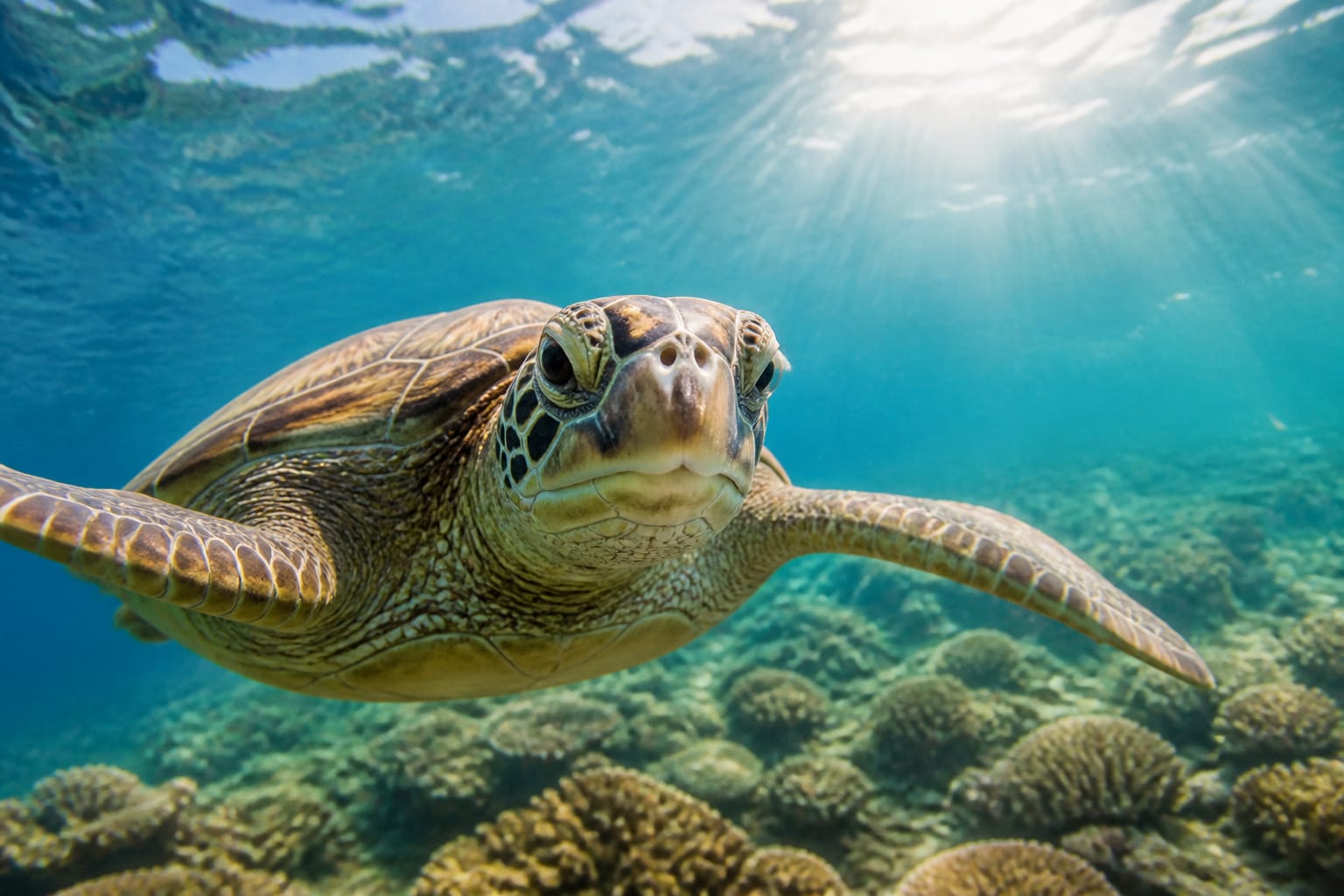
A green sea turtle, roughly seventy centimetres in carapace length, had a length of monofilament net wrapped around the base of her left front flipper and trailing behind her, tangled with the float. The flipper was swollen and there was visible abrasion where the line had cut into the leading edge. The whole assembly was dragging her sideways every time she tried to surface.
Entanglement in derelict fishing gear — "ghost gear" — is one of the largest single threats to sea turtles worldwide. Monofilament doesn't degrade meaningfully on a timescale that matters, and a net fragment continues to fish indefinitely. The specific danger for turtles is that they are air-breathers: an entangled turtle that cannot reach the surface drowns, and one that can reach the surface but can't feed properly starves slowly with a constricted limb that may eventually be lost.
Marchetti was carrying a line-cutter on her BCD, which is the single most important detail in this story and the reason it ended well. She did not attempt to unwrap the net, which risks tightening it and which requires holding a distressed hundred-and-forty-pound animal still underwater. She worked the trailing section first, cutting the float free so the turtle stopped being dragged, then made three cuts on the wraps around the flipper, from the outside in, with the flat of her hand between the blade and the skin.
The whole cut took a little over two minutes. Her buddy filmed it and, more usefully, held the severed net so none of it drifted back onto the reef.
The turtle did not leave immediately. She stayed in the area for perhaps thirty seconds, moved the flipper twice through its full range, and then swam off toward open water at normal speed.
Marine biologists are cautious about the interpretation everyone wants to reach. There is no strong evidence that sea turtles solicit help from humans in a deliberate, understood sense, and turtles habituated to divers on frequently dived reefs approach people for reasons that have nothing to do with distress. What is well documented is that entangled and injured marine animals sometimes behave atypically — reduced flight response, orientation toward large moving objects — and that divers on popular reefs are often the first responders by default.
The practical takeaway from the local marine rescue network, which logged the incident and collected the net: carry a cutting tool on every dive, and know the protocol before you need it. Cut trailing gear first to stop the drag. Never remove a hook or deeply embedded line yourself. Report the animal's location, size, and the type of gear. Bring the gear up rather than leaving it. And if an animal is severely wounded, badly entangled, or unable to dive, don't attempt a full disentanglement — report it, stay with it if you can, and let a permitted response team handle it.
The network's coordinator put the numbers plainly: they pulled two hundred and ninety kilograms of derelict gear off the same three reefs last year. "Every diver who carries a cutter is a response unit," he said. "That's not sentiment. That's just the ratio of turtles to boats."