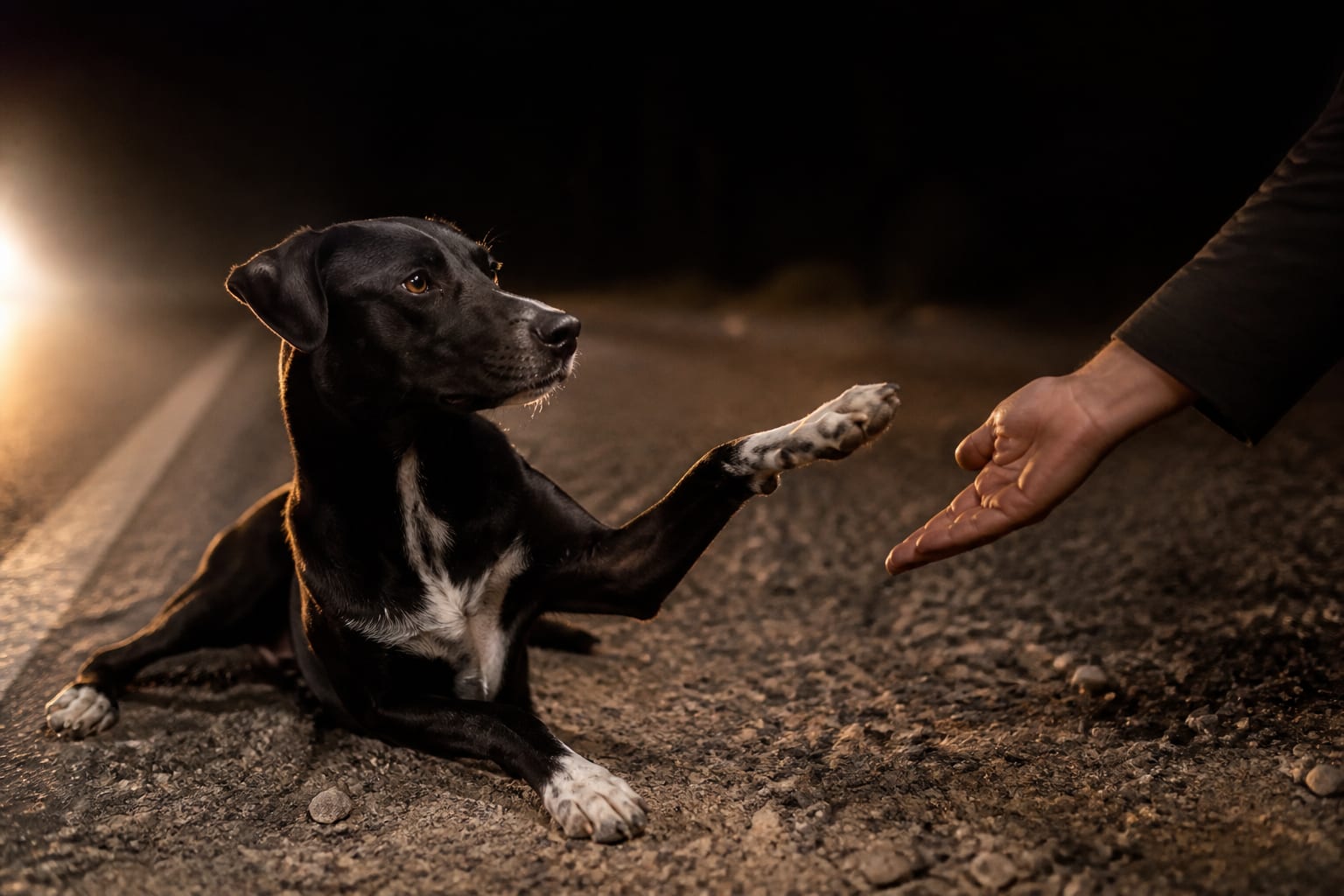
Zully Vasquez Ventura had been feeding the same German shepherd mix on the main road through Colony Ridge, outside Cleveland, Texas, for close to two years. She could whistle him in from a distance and he would come at a run — but only as far as the food. Every attempt to touch him ended with the dog backing off. He would not be caught, and despite repeated posts asking rescues for help with him, nobody offered.
Ventura, who feeds strays across the neighbourhood and networks with rescues to place them, has helped thousands of dogs there. This one she could not solve.
Then a McDonald's opened nearby, and the dog developed a career.
Ventura first noticed the change when she pulled into the parking lot and found him working the queue: following cars, barking at driver's-side windows until somebody threw something out of one. That much is straightforward opportunism, and any street dog near a food source learns it. What she saw at the order speaker was not. According to her account, the dog barked at her, held eye contact until he was sure he had it, and then deliberately turned his head toward the menu screen — after which he followed her car around to the collection window. She bought him a Big Mac and handed it over.
It is worth being careful about what that behaviour is and isn't. The dog has not understood a menu. What he has almost certainly done is chain together a sequence of learned associations: cars stop at this box, humans at this box produce food a short distance further on, and barking plus eye contact reliably speeds the process up. That is still a substantial piece of learning, built from repeated trials with clear reinforcement, and the head-turn is the kind of directed signalling that dogs develop specifically toward humans — the same referential gesturing that shows up in laboratory work on dog-human communication. It looks like ordering. It is closer to operating a machine that happens to be made of people.
Ventura filmed him doing it and posted the footage with another appeal for help. This time it worked: Mike's Chance Animal Rescue offered to take him. She went back to the drive-thru with a crate, ordered a Big Breakfast, gave the pancakes to her daughter and used the eggs to draw him inside. After two years of failed approaches, the thing that caught him was breakfast.
She named him Big Mac, on the reasoning that the first thing she ever bought him was a Big Mac. He is roughly two years old, about fifty-five pounds, and Ventura says the change in him was visible within hours of getting indoors — the wariness dropped away and what was underneath it was a playful, funny, distinctly silly dog. He has since been vetted, moved to a foster home, and is now up for adoption.
Ventura's own conclusion is the one she has been repeating for two years: scared dogs are not damaged dogs, and most of them need a chance rather than a rescue. Her longer-term ask is less shareable and considerably more useful — she is looking for anyone who can bring low-cost spay-and-neuter services into Colony Ridge, so that the next dog who has to invent a way to feed himself doesn't have to.