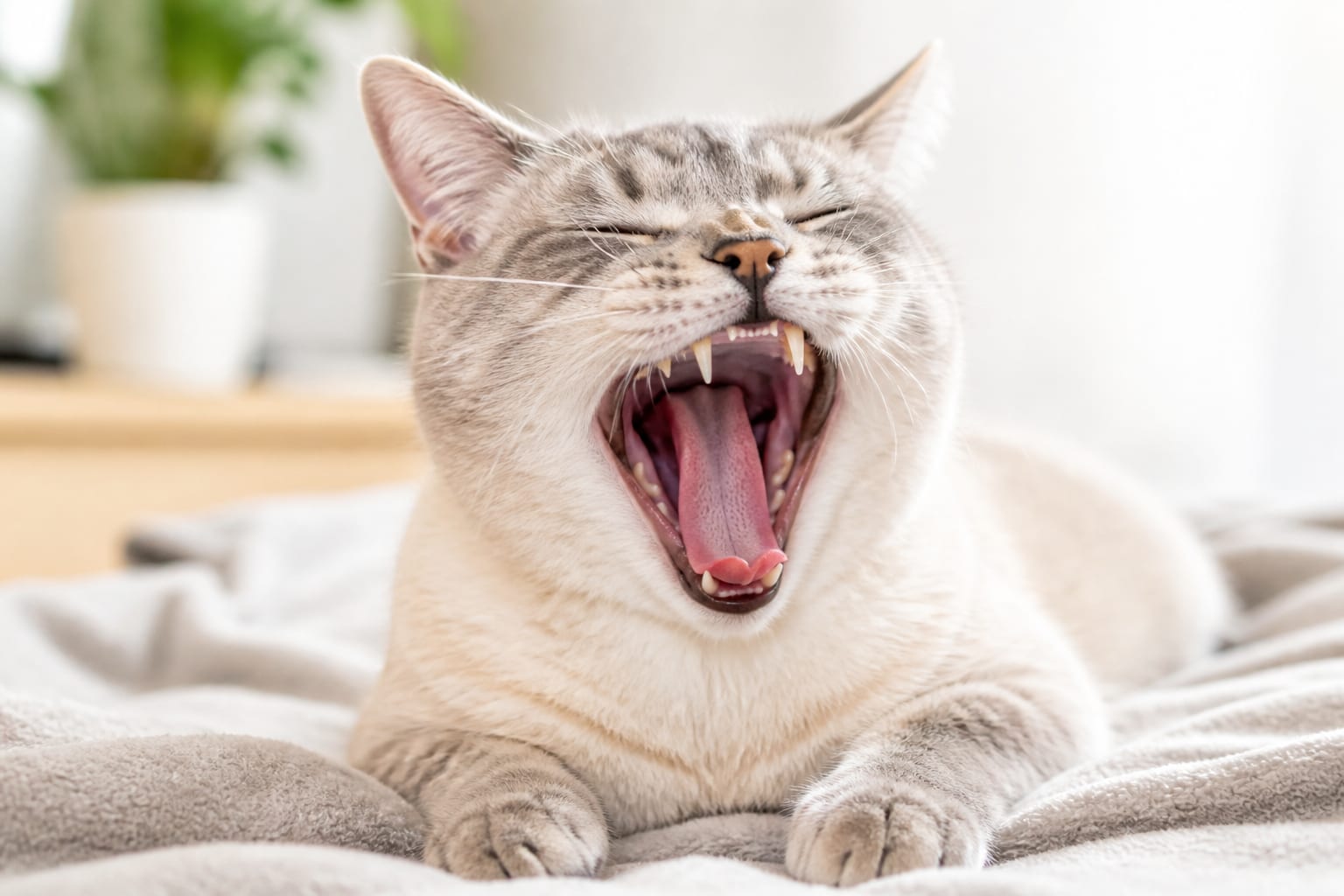
Reviewed by a veterinarian. General guidance only. Dental disease can only be properly assessed by a veterinarian, and grading requires examination under anaesthesia with radiographs.
The figure most commonly cited in feline medicine is that somewhere between fifty and ninety percent of cats over the age of three have some degree of periodontal disease. The range is wide because studies define and grade it differently, but no one in the field argues about the direction: it is extremely common, and it is very commonly missed.
The reason it's missed is a single behavioural fact that owners find genuinely hard to believe. Cats with painful mouths keep eating. A cat with advanced periodontal disease, a resorptive lesion exposing dentine, or a fractured tooth will typically eat a full meal every day, because a cat that stops eating in the wild dies. The instinct to conceal pain is stronger than the pain.
"Owners tell me it can't be his teeth because he's eating fine," said Dr. Halvard Ibarra, a veterinary dentist. "I extract eight teeth, and three weeks later they call to say he's playing again, and he's grooming again, and he's sitting on their lap for the first time in two years. They didn't have a cat with a dental problem. They had a cat they thought was aloof, or getting old."
The signs are subtle and mostly aren't in the mouth. Bad breath is the most reliable one and the most dismissed — halitosis in a cat is not normal and is not "just cat breath." Beyond that: dropping food or chewing on one side, a sudden preference for wet food over dry, pawing at the face, drooling, a decline in grooming that shows as a scruffy or matted coat, hiding, reduced tolerance for being touched around the head, and a slow retreat from interaction that gets attributed to age.
Two conditions in particular deserve naming, because they're specific to cats and they surprise people.
Tooth resorption affects a large share of adult cats and involves the body's own cells destroying the tooth structure, often starting at the gum line. It is painful, it is not caused by anything the owner did, brushing does not prevent it, and the only treatment is extraction. It's frequently invisible on visual exam and only shows on dental radiographs, which is one of the main reasons a proper dental assessment requires anaesthesia and x-rays rather than a look with a penlight.
Stomatitis is a severe inflammatory response of the mouth tissue, disproportionate to the amount of plaque present, and it is one of the most painful conditions in feline practice. Affected cats may need full-mouth extraction, and the counterintuitive part is that they usually eat better afterwards, not worse.
On prevention, Ibarra is blunt about the gap between the ideal and the achievable. Daily brushing with a pet-specific enzymatic paste is the gold standard and genuinely works; most owners cannot sustain it, and starting with an adult cat who has an already-painful mouth is close to impossible. Realistic alternatives are products carrying the Veterinary Oral Health Council seal, water additives with actual evidence behind them, and — the one that matters most — regular professional assessment.
Never use human toothpaste, which contains fluoride and sometimes xylitol. Do not attempt to scale tartar yourself with any tool bought online. And treat anaesthesia-free dental cleaning as what the veterinary dental community considers it: cosmetic. It removes visible tartar above the gum line, does nothing about disease below it, and gives owners false reassurance for another two years.
The practical ask is small. Smell your cat's breath this week. If it's bad, book an exam and use the word "dental."