Reviewed by a veterinarian. General guidance only. Severe noise phobia is a medical condition — talk to your clinic about a plan before storm season, not during a storm.
The most common piece of advice given to owners of storm-phobic dogs is to mask the noise. Turn on a fan, play white noise, put the television up. It helps some dogs a little, and for the dogs with severe storm phobia it frequently does almost nothing, and owners conclude their dog is beyond help.
The reason is that thunder is only one of at least four things the dog is reacting to, and it's usually the last one to arrive.
Barometric pressure. Dogs appear to detect the pressure drop that precedes a storm, which is why so many owners report their dog becoming anxious twenty to forty minutes before there is anything to hear. The behaviour that looks like clairvoyance is one of the strongest clues that you're dealing with genuine storm phobia rather than a simple noise startle.
Static charge. This is the most underappreciated element. Storm systems build static in the air, and a dog's coat accumulates charge that can discharge in small shocks — often noticed by owners as their dog trying to get into a bathtub, behind a toilet, or into a shower stall during a storm. Those are the grounded, porcelain-and-tile places in the house. A dog crawling into the bathtub is not being irrational; it is doing something that works.
Infrasound. Thunder produces low-frequency energy below the range of human hearing that travels far further than the audible crack. A dog can be responding to a storm cell thirty kilometres away that you have no evidence of.
Ozone and scent change. The smell of an approaching storm is a real chemical signature, and it's an easy thing for a dog to learn as a reliable predictor.
Which means white noise addresses roughly one quarter of the problem.
What veterinary behaviourists recommend instead is layered, and the pieces that matter most are the unglamorous ones. Build a genuine safe space, and let the dog choose it — if he picks the bathroom, the plan is the bathroom, not the crate you bought. Make it interior, windowless if possible, with bedding and a covered top. Leave it open at all times, never confine him in it, and never use it for anything he dislikes.
Address static directly: a light rub-down with an unscented dryer sheet or a slightly damp cloth reduces coat charge, and access to a tiled bathroom gives him the grounded surface he's looking for.
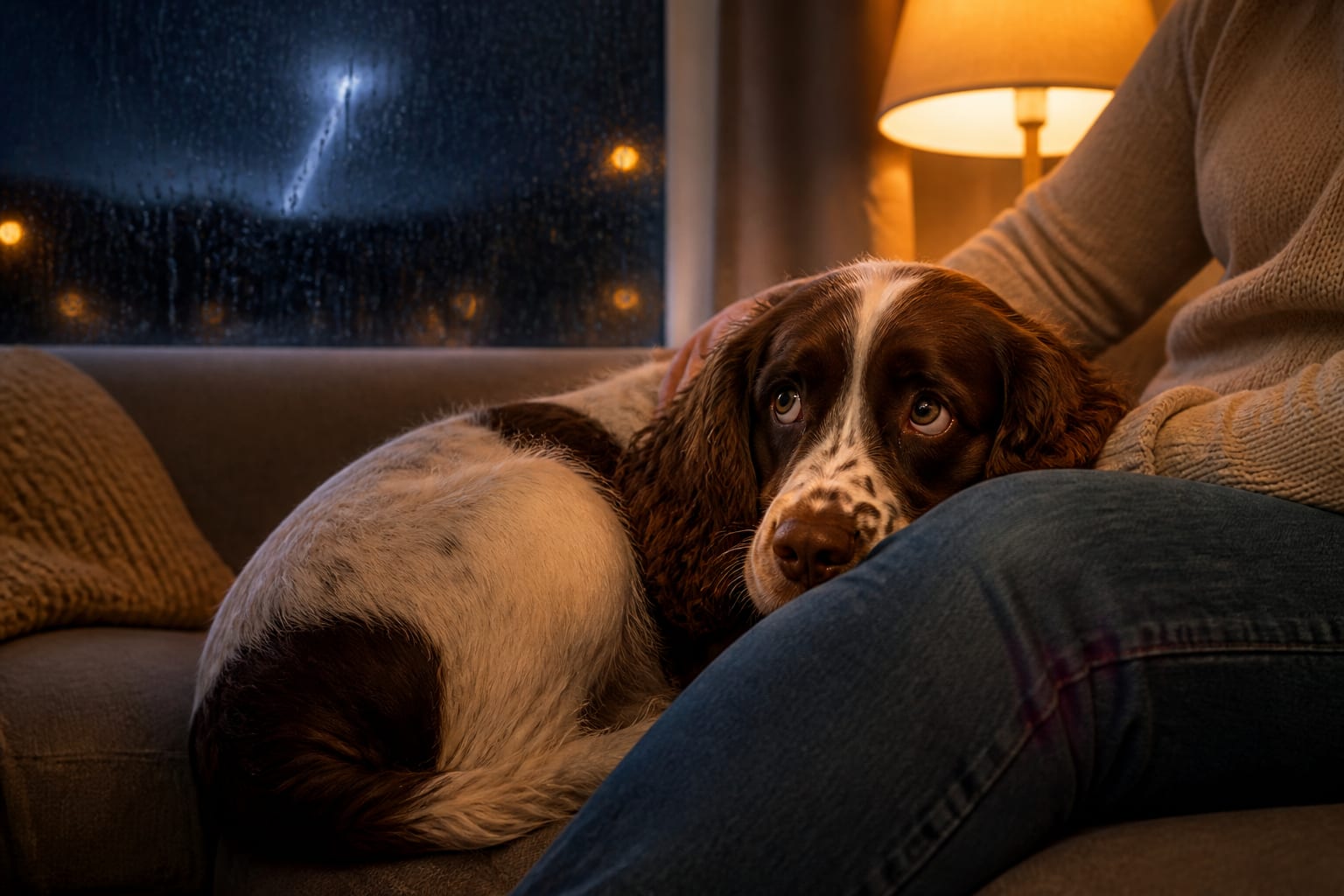
Do not stop comforting your dog. The old advice that reassurance "reinforces fear" has been thoroughly rejected by the veterinary behaviour field. Fear is an emotional state, not an operant behaviour, and you cannot reward it into being worse. If your dog wants to press against you, let him.
Then there is medication, and this is where owners of severely affected dogs are most often let down. Storm phobia is a progressive condition — untreated dogs typically get worse year over year, and the panic frequently generalises to fireworks, gunshots, and eventually to any loud noise. Modern practice uses two tiers: a daily medication for dogs with severe generalised anxiety, and a fast-acting situational medication given before the storm, which is the part that matters. Given during a full panic, the same drug is far less effective.
"Waiting until the dog is already screaming is the single most common mistake," said Dr. Fenella Oyibo, a veterinary behaviourist. "Watch the forecast. Medicate on the pressure drop, not on the thunder. And please stop apologising to me for asking about medication for a dog who spends nine nights a summer in genuine terror."
Sound-based desensitisation with recorded thunder can help as part of a program, but it's slow, it has to be done far below the dog's reaction threshold, and it should be run in the off-season. Attempting it in July, during storms, generally makes things worse.