Reviewed by a veterinarian. General guidance only. If your rabbit has stopped eating or passing droppings, that is an emergency — call an exotics vet immediately, not tomorrow.
Rabbits are among the most commonly kept and most consistently mis-fed pets in the world, and the pet aisle is a significant part of the reason. The colourful muesli-style mixes, the seed-and-corn blends, the yogurt drops, and the picture of a carrot on the front of the bag all point away from what a rabbit actually needs.
The correct diet, in proportion, is close to embarrassingly simple.
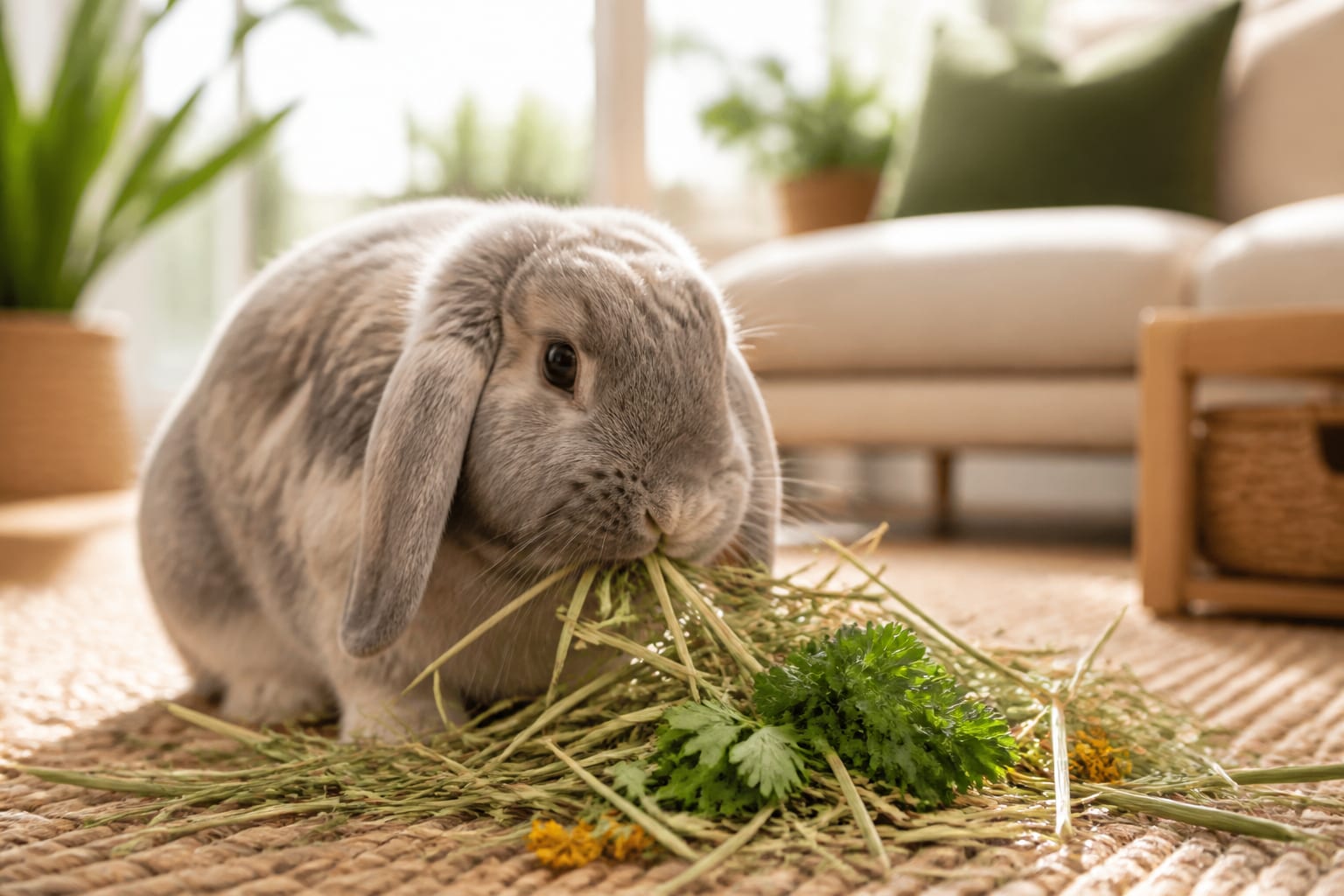
Unlimited grass hay: roughly 80 to 85 percent of intake. Timothy, orchard, meadow, or oat hay, available at all times, in a volume at least the size of the rabbit's own body every day. This is not filler and it is not bedding. It is the entire foundation, for two reasons.
The first is dental. Rabbit teeth grow continuously — on the order of a couple of millimetres a week — and they are worn down by the specific side-to-side grinding motion required to chew long-strand hay. Pellets and soft foods don't produce that motion. A rabbit fed mostly pellets develops malocclusion and molar spurs: overgrown teeth that cut into the cheek and tongue, cause severe pain, and require repeated filing under anaesthesia for the rest of the animal's life.
The second is gut motility. The rabbit digestive system needs a continuous flow of indigestible fibre to keep moving. Take that away and you get gastrointestinal stasis — the gut slows, gas builds, the rabbit stops eating, and it becomes life-threatening within a day. GI stasis is one of the most common emergency presentations in rabbit medicine and it is overwhelmingly diet-related.
Fresh leafy greens: roughly 10 to 15 percent. A packed cup or two per kilogram of body weight daily, from a rotating selection: romaine and other dark leaf lettuces, coriander, basil, parsley, dill, mint, dandelion greens, and small amounts of kale or spring greens. Rotate rather than feeding one green exclusively.
Plain pellets: a small measured amount. Roughly an eighth of a cup per two kilograms of body weight per day for an adult — a supplement, not a meal. They must be uniform grass-hay-based pellets with no seeds, corn, dried fruit, or coloured pieces. Muesli-style mixes encourage selective feeding, where the rabbit eats the sugary bits and leaves the fibre, and they have been associated with dental and gut disease in published work.
Fruit and carrot: a treat, measured in teaspoons. Carrots are a root vegetable and are high in sugar. The cartoon rabbit with a carrot has done real damage. A thin slice a few times a week is fine; a carrot a day is not.
Things to remove entirely: yogurt drops and any dairy, seed or nut treats, bread and crackers, breakfast cereal, anything marketed as a "honey stick," iceberg lettuce, and grass clippings from a mower, which ferment fast and can cause serious upset.
Two other essentials. Water should be in a heavy open bowl, not a bottle — rabbits drink substantially more from a bowl, and hydration is protective against both stasis and urinary sludge. And if you see your rabbit eating its own droppings, that's normal and necessary: caecotrophs are a nutrient-rich second-pass product, and a rabbit that stops producing or eating them is unwell.
The warning sign that matters more than any other: a rabbit that hasn't eaten in twelve hours, or whose droppings have become small, sparse, or absent, is in a genuine emergency. Rabbits deteriorate faster than dogs and cats and they hide illness comprehensively. "By the time a rabbit looks sick to an owner, we're usually already behind," said Dr. Emeka Sundstrom, an exotics vet. "There is no version of waiting until Monday."