Reviewed by a veterinarian. General guidance only. Ask an exotics vet about introductions, sexing, and neutering before pairing any animals.
Switzerland made it illegal in 2008. Austria has similar provisions, and several other jurisdictions treat solitary housing of guinea pigs as a breach of animal welfare law. The reasoning is not sentimental — it comes out of a fairly consistent body of research on a species whose social structure is unusually rigid.
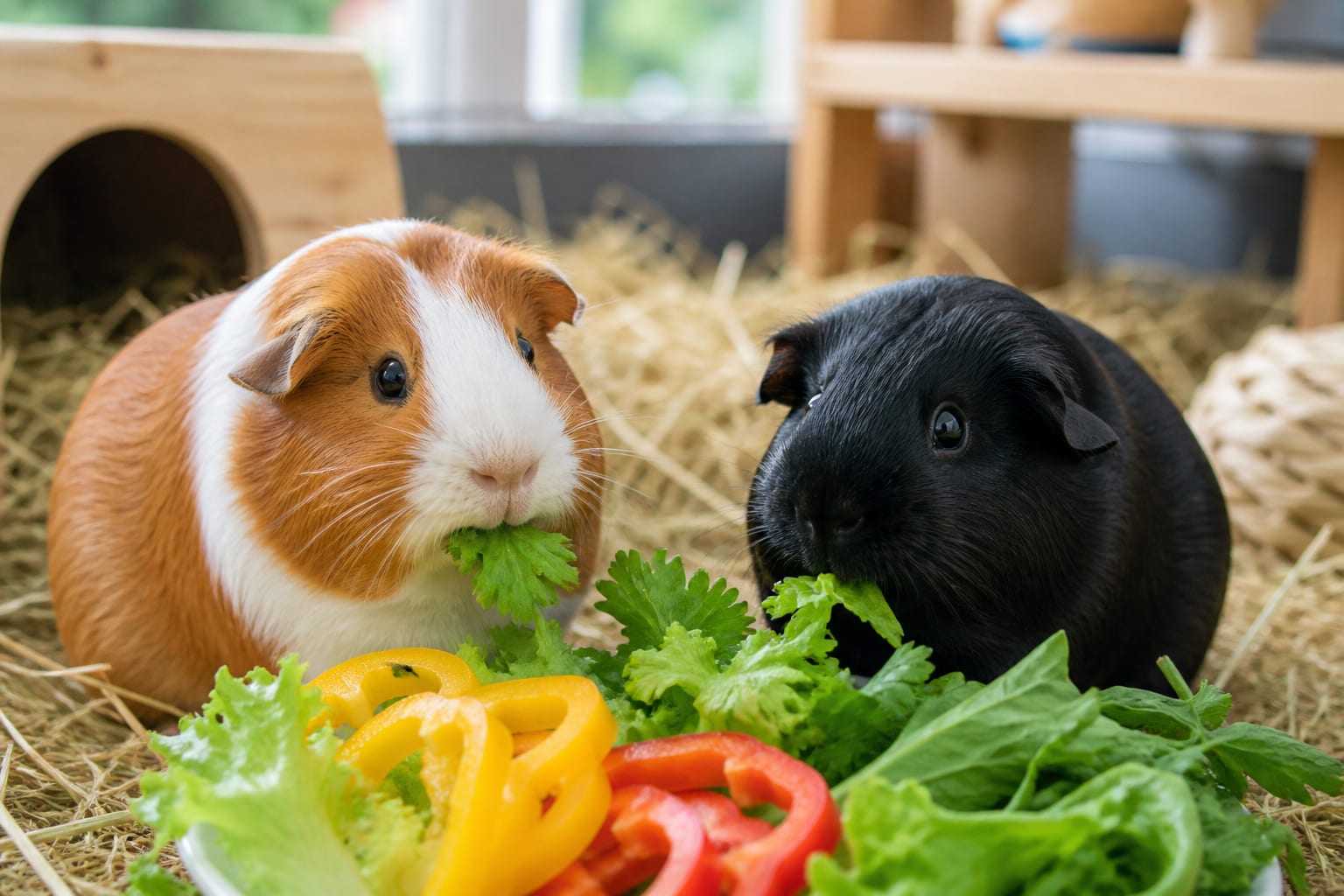
Guinea pigs are obligately social herd animals. In their wild range in South America they live in stable groups, and their behavioural repertoire is built almost entirely around conspecifics: contact calls, the "wheek" that functions as a group-cohesion signal, mutual grooming, huddling for thermoregulation, and coordinated vigilance while feeding. A single guinea pig has no outlet for most of what it is built to do.
The measurable consequences of solitary housing include chronically elevated stress markers, more time spent hiding, reduced activity and exploration, and reduced food intake. "Depression" is not a diagnosis a vet will write down, but the behavioural picture in a long-term single guinea pig is recognisable and grim: an animal that sits in a shelter almost permanently, doesn't vocalise, and stops responding to enrichment.
"The most common thing I hear is that theirs is fine because they handle it every day," said Dr. Ilinca Wardrop, an exotics veterinarian. "Human handling is a completely different category of interaction. You cannot huddle with a guinea pig, you don't speak its language, and you're not there for twenty-three hours of the day. A friendly single pig is not the same as a satisfied one."
Pairing has to be done properly, and this is where owners get into trouble. The combinations that work: two females, an established group of females, a neutered male with one or more females, or two males who were littermates and have never been separated. Two unrelated adult males can work but carry the highest risk of serious fighting and need a much larger space.
Two absolute rules. First, an intact male and a female will breed, immediately and repeatedly, and guinea pig pregnancy carries genuine maternal mortality risk — particularly in females bred for the first time after about seven months, when the pelvic symphysis has fused. Second, males must be neutered well in advance and given several weeks before introduction, because they remain fertile for a period afterwards.
Introductions themselves are done on neutral ground, in a space larger than either animal's home, ideally with two of everything — two hides, each with two exits, so nobody can be cornered — and a generous pile of scattered hay to give them something to do besides evaluate each other. Chasing, mounting, teeth chattering, and rumbling are normal dominance behaviour and should not be interrupted. Full-contact fighting with lunging at the face, or any blood, ends the session immediately.
Never bathe them or apply a scent to "make them smell the same," which is folk advice that does nothing useful and adds stress. And never house guinea pigs with rabbits, which was standard advice for decades and is now advised against: rabbits can injure them with a single kick, they have incompatible dietary requirements, and rabbits commonly carry Bordetella without symptoms while it causes serious respiratory disease in guinea pigs.
The other point Wardrop makes to anyone adopting: guinea pigs need substantially more floor space than commercial cages provide — the widely used minimum for a pair is around 0.7 square metres and more is meaningfully better — plus daily vitamin C from fresh vegetables, because guinea pigs cannot synthesise it and scurvy is still something she diagnoses. "They're not a starter pet," she said. "They're a five-to-seven-year commitment to a small herd."