Rye worked sheep for nine years on a hill farm outside Ballinclare, and then his hips gave out in the way that hips do, and his owner retired him to the yard with a bed by the stove and instructions to do nothing.
Rye did not do nothing. Rye took over the ducks.
"There was no decision made," said Fionnuala Deasy, who has farmed the property for twenty-two years. "I let the ducks out one morning in March and he was there. He put them in a group. He walked them to the pond. And then he sat down about six feet away and watched them until I called him in for lunch."
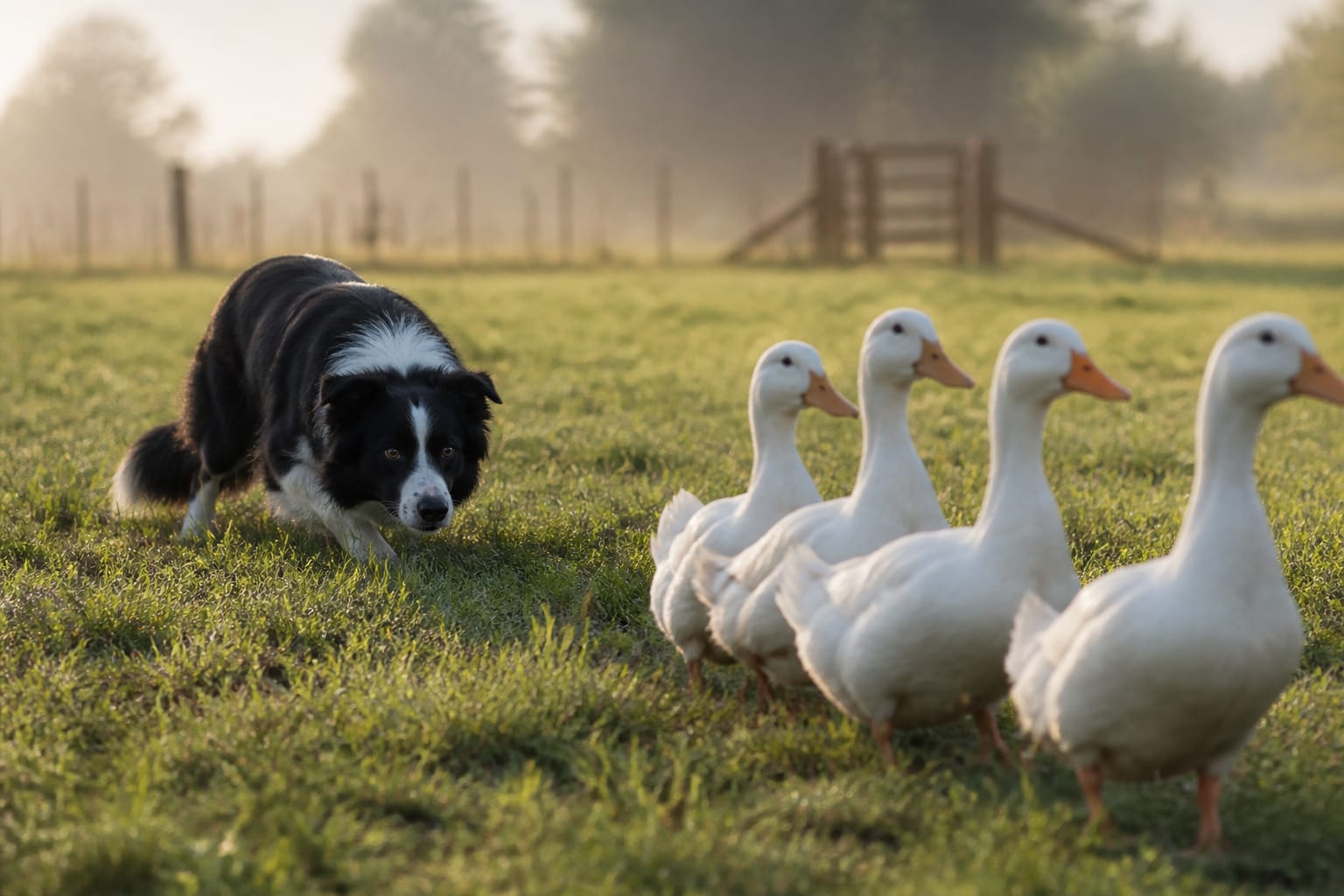
He has done it every day since. The flock — nineteen Khaki Campbells and four Aylesburys — now moves in a loose but genuinely organized mass from the shed to the pond in the morning and back at dusk, with Rye running a wide, slow arc behind them.
What he is doing is recognizable to anyone who has watched a trial: the outrun, the lift, the fetch, the drive. He is doing it at about a third of his old speed, with far less crouch, and with the eye — the fixed stare that a collie uses to move stock without touching it — held for shorter stretches than he could manage at five.
The behavior itself isn't a mystery. Herding in working collies is a heavily selected, highly self-reinforcing motor pattern — a modified predatory sequence with the kill bite bred out and the stalk-and-gather amplified. Dogs with that much drive don't stop needing to express it because the sheep are gone. They redirect it. In suburban homes, the same drive lands on children, bicycles, and vacuum cleaners, and it becomes a behavior problem. On a farm with ducks, it lands on ducks.
"This is the version people don't see," said Ewan Traoré, a veterinarian who works with working-dog owners on retirement transitions. "The question with a retired herding dog is never whether to give it a job. It's which job, and how do we make it small enough for the joints. Ducks are perfect. They're slow, they're low to the ground, they don't scatter far, and they don't run a dog into the ground the way sheep do."
Deasy has had to impose limits. Rye gets one session in the morning and one in the evening, twenty minutes each, and is brought in afterward whether he agrees or not. He is on a joint-support regimen and daily anti-inflammatories, and he swims in the pond twice a week — hydrotherapy in the loosest possible sense, but her vet approves. On wet cold mornings, he stays in and complains about it audibly.
The ducks' side of the arrangement is harder to characterize. They do not appear to be distressed; they eat, lay, and swim normally, and they do not flush when he approaches. Deasy's theory is that they have simply never known a world without him. "They were ducklings when he started," she said. "As far as they're concerned, that's what a field is. It has grass, and it has water, and it has a dog at the edge of it."