Priya Sandoval and her running partner had passed the same storm grate on Alder Street four times a week for two years. On Sunday morning they both stopped at it.
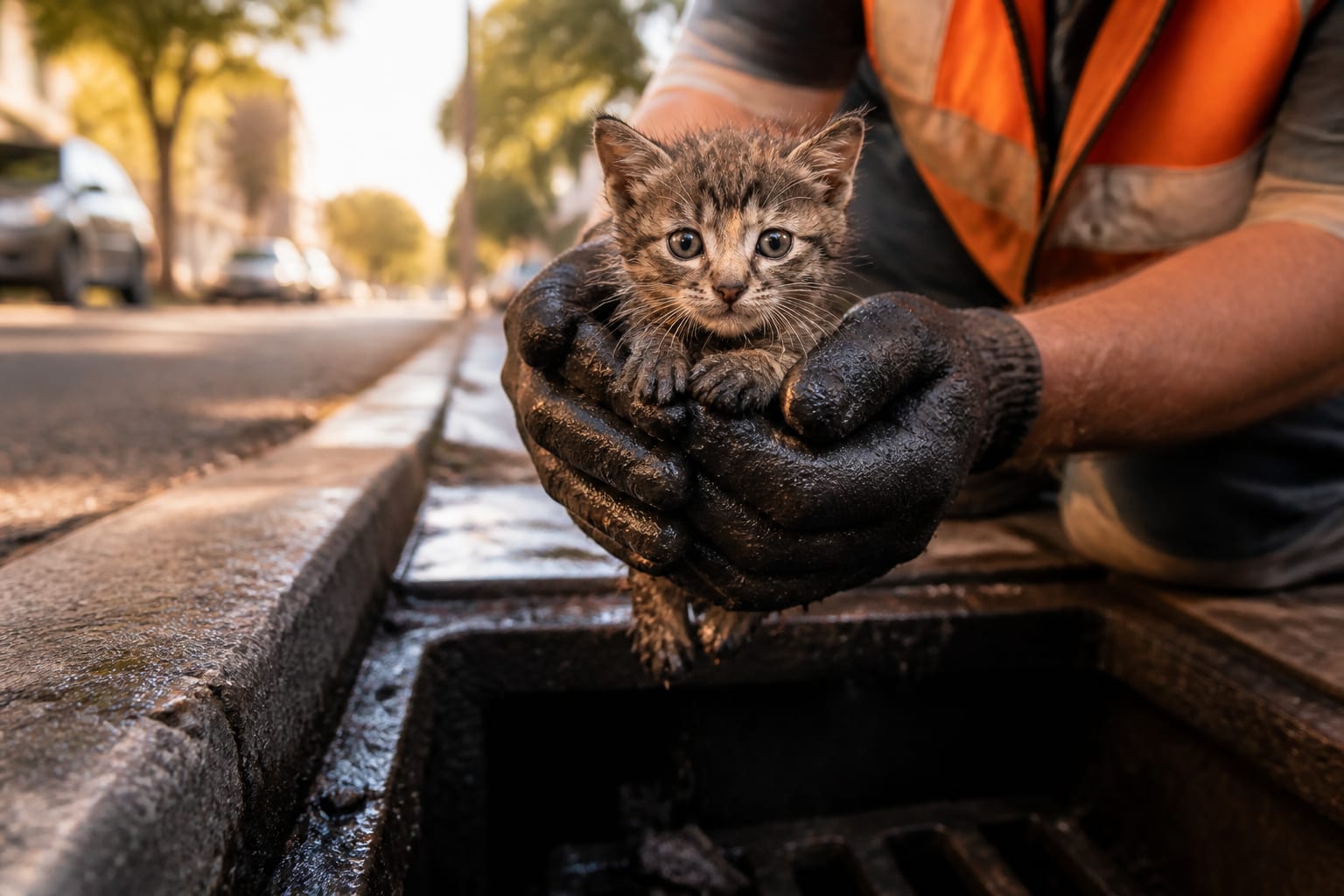
The sound underneath was faint and rhythmic — the specific, unmistakable pitch of a very small cat in distress. Sandoval got down on the pavement and shone her phone light through the slots. About six feet below, on a dry ledge beside the drain channel, a grey kitten was pressed flat against the concrete, mouth open, screaming.
The pair called the city's public works after-hours line, which is the correct call in this situation and also the one most people don't think to make. Storm grates are municipal infrastructure; fire crews will often decline to lift them, and prying at one without the right tool is a good way to drop it on whatever is underneath. A works crew arrived in forty minutes with a grate hook and a tripod.
The rescue itself took nine minutes. A technician named Luis Ferreira went down on a ladder with a pillowcase — the standard tool for a frightened cat in a confined space, because it contains a scared animal without pinning it — and came up with a kitten that weighed slightly under a pound and was, by everyone's estimate, five weeks old.
"She was completely dry," Ferreira said. "That's the part that tells you how she got there. If she'd washed down in the rain she'd have been soaked and hypothermic. She walked in, or she was small enough to fall through the slots, and then she couldn't get back up."
The kitten went to the Alder Valley Humane Society and then, the same afternoon, into a foster home. Her intake exam found her dehydrated and underweight but structurally fine — no fractures, no fluid in her lungs, and no sign of the respiratory infection that usually accompanies a kitten found alone outdoors. She was fed a warmed slurry of kitten formula and wet food every three hours for the first two days.
Shelter staff spent Monday and Tuesday looking for the rest of the litter. Two volunteers walked the block with a thermal camera at dusk, checked the crawl space of the vacant building on the corner, and set a humane trap baited with sardines near the grate. They found nothing, which the shelter's intake coordinator, Bettina Ahn, said is the most common outcome. "A five-week-old kitten alone in a drain usually means the mother moved the litter and lost one, or the mother is gone," she said. "We look because sometimes we're wrong."
The kitten, now named Alder, has doubled her body weight and will be adoptable at the end of the month. Ahn's ask of the public is narrower than you'd expect: if you hear something under a grate, do not reach in, do not try to lift it, and do not walk away. "Call public works and stay there," she said. "The staying is the part that actually matters. Sound carries strangely in a drain, and if you leave, the next person who hears it is starting from zero."