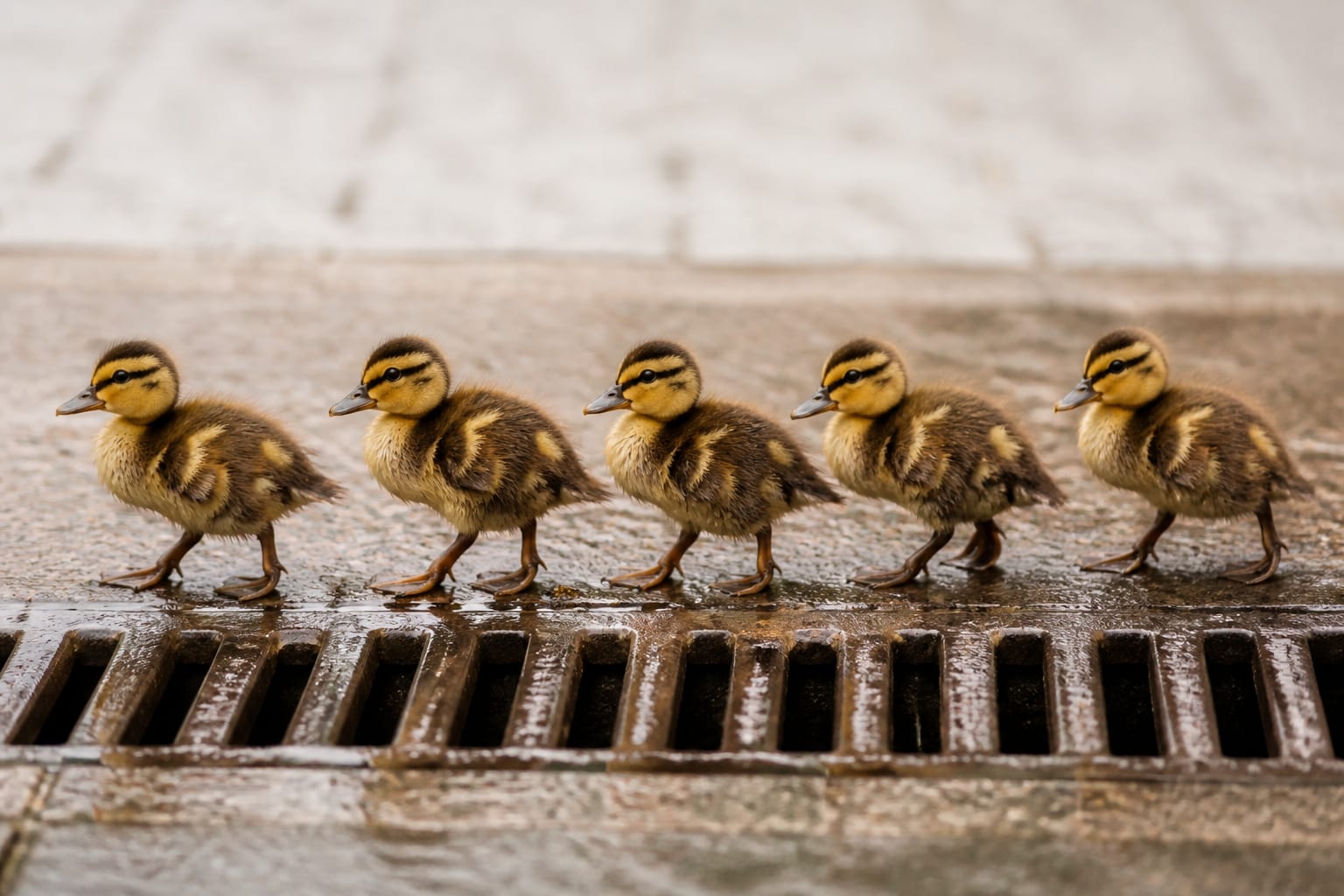
A mallard hen had nested in a landscaped median on Kestrel Avenue, which is a common and completely reasonable decision for a duck and a catastrophic one for her ducklings. Between the median and the retention pond she was heading for lay two lanes of traffic and a line of storm grates with gaps just wide enough for a day-old duckling to fall through.
Nine of her eleven ducklings went down the third grate.
The first person to notice was a delivery driver named Ade Bankole, who initially saw only a duck standing in the street refusing to move. Then he heard the peeping under the pavement. He parked his van diagonally across the lane to shield the hen from traffic and called animal control, then stood in the road for twenty-five minutes waving cars into the far lane.
"People kept telling me to move the duck," he said. "You can't move the duck. The duck knows where her kids are. I know where her kids are because of the duck."
That instinct is exactly right, and it is the reason this rescue worked. Wildlife responders who handle storm-drain duckling calls will tell you that the reunion is the hard part, not the retrieval. Ducklings imprint on their mother within the first day or two, and a hen that has been chased off will often abandon the site within an hour. Once she's gone, nine ducklings become nine weeks of hand-rearing at a rehabilitation center, with markedly worse odds.
An animal control officer and a public works technician lifted the grate at 2:15 p.m. Eight ducklings were on the ledge below, huddled in a corner, silty but active. The ninth had gone farther down the channel and was retrieved with a long-handled net after ten minutes of coaxing with a recording of hen calls played from a phone — a standard and slightly absurd-looking trick that works remarkably well.
The ducklings were put in a cardboard carrier and walked, not driven, sixty yards to the retention pond, with the hen following at a distance of about fifteen feet the entire way. Responders set the carrier on the bank, opened it, and stepped back. The hen came in immediately. She was in the water with all nine behind her inside two minutes.
"That's the best version of this call," said Officer Deirdre Nkemelu, who has handled eleven of them in six years. "We are not the heroes of that story. The guy who parked his van sideways is the hero of that story, and the duck who wouldn't leave is the other one."
City engineering has since added narrow-slot inserts to four grates along that stretch — a fix that costs a few hundred dollars per grate and that wildlife groups have been requesting in nesting corridors for years. If you find yourself in this situation: do not chase the hen, do not try to lift the grate yourself, and call your municipal public works line rather than 911. And if you can safely do it, stand there until someone comes.