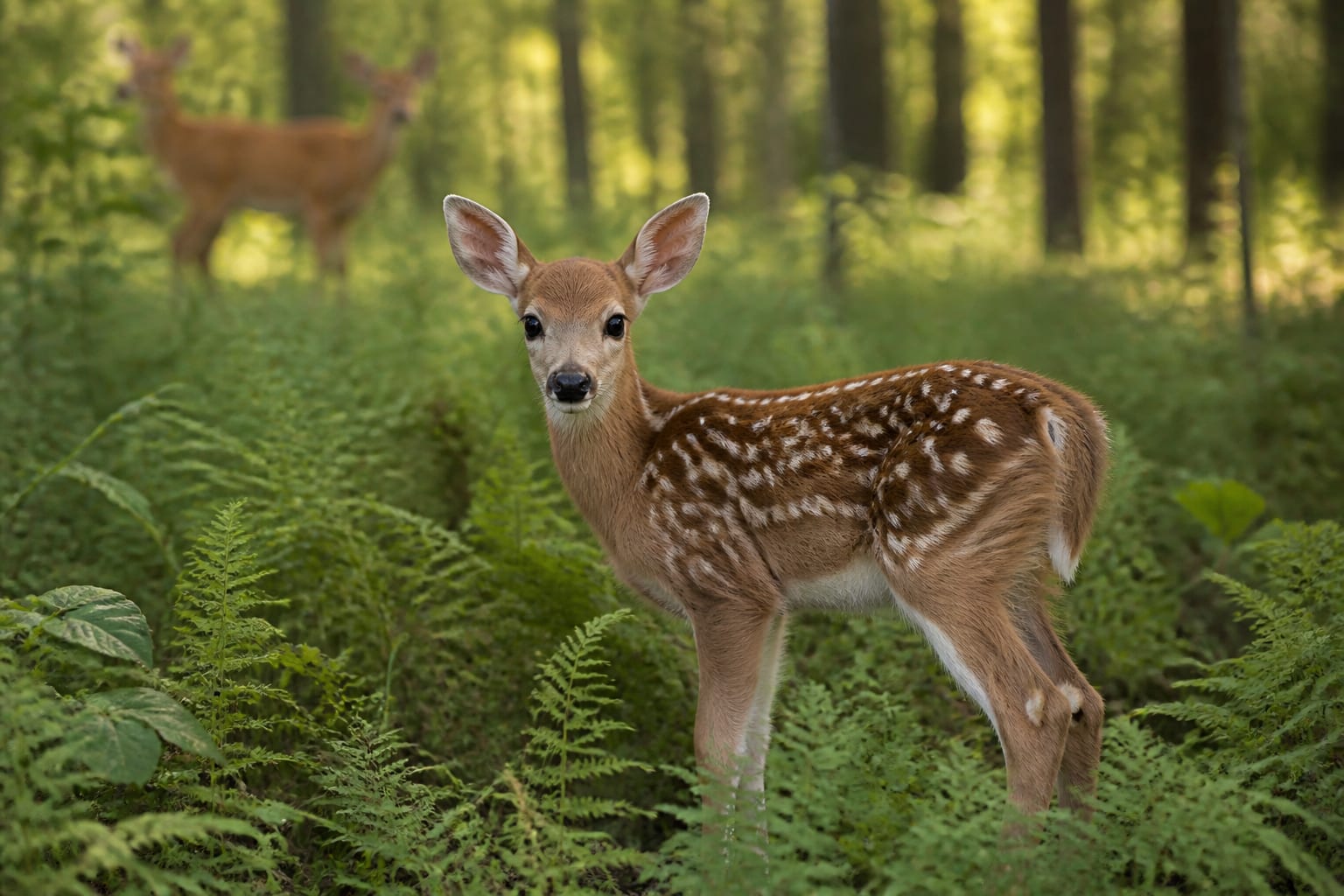
The call came into the Rushmere Wildlife Center at 8:20 on a Saturday morning: a fawn, alone, curled in the grass at the edge of a mown field, motionless for over an hour. The caller had a towel and a box in her car and wanted to know whether to bring her in.
The answer, delivered as gently as possible by a rehabilitator who fields this call eight or ten times every spring, was no. Put the towel away. Go back inside. Watch from a window if you must.
White-tailed deer are what biologists call a "hider" species. For roughly the first two to four weeks of life, a fawn's primary anti-predator strategy is to remain absolutely still in cover while its mother forages away from it — often several hundred metres away, and often for six to twelve hours at a stretch. Newborn fawns have very little scent, a coat that breaks up their outline, and an instinct to freeze rather than flee. The doe returns to nurse a few times a day, usually at dawn and dusk, and deliberately keeps her distance the rest of the time because her own scent and movement are what would draw a predator to the fawn.
A fawn lying alone in the grass, in other words, is not evidence of anything having gone wrong. It's evidence of the system working.
"Every single spring, well-meaning people bring us healthy fawns," said the centre's director, Odalys Fenn. "It is the most common wildlife mistake there is, and it's the hardest one to undo, because the moment that animal is in a car it has lost the only mother it will ever have. We can raise it. We are not as good at it as she was."
The signs that a fawn does need intervention are specific and mostly obvious once you know them: it is walking around crying persistently, which a hidden fawn does not do; it is lying on its side rather than curled with legs tucked; it is covered in fly eggs or maggots; it has visible wounds, a broken limb, or diarrhoea; it is cold to the touch; or the mother is confirmed dead nearby. Anything short of that list, the answer is to leave it and check again in twelve hours from a distance.
In this case the caller agreed to wait. Fenn asked her to mark the location, stay indoors, keep her dog on lead and away from the field, and check at dusk with binoculars.
At 8:15 that evening the doe came out of the treeline. The caller watched the fawn stand up, nurse for about four minutes, and follow her mother about twenty metres to a new bedding spot in taller grass — the routine relocation a doe performs to keep the site from being learned by predators.
Fenn's other point is about the fawns that are genuinely picked up. In most jurisdictions it is illegal to keep native wildlife without a permit, and the outcome for a hand-raised deer is frequently poor: fawns raised without conspecifics imprint on people, lose appropriate fear, and as adults — particularly bucks in rut — become dangerous enough that they often have to be euthanised. "The kindest thing you will do for a deer this year is drive past it," she said. "I know how that sounds. It's still true."
If a fawn has already been moved, the centre's advice is to return it to the exact spot within twenty-four hours and leave. Does search for missing fawns persistently, and reunions after a day are common.