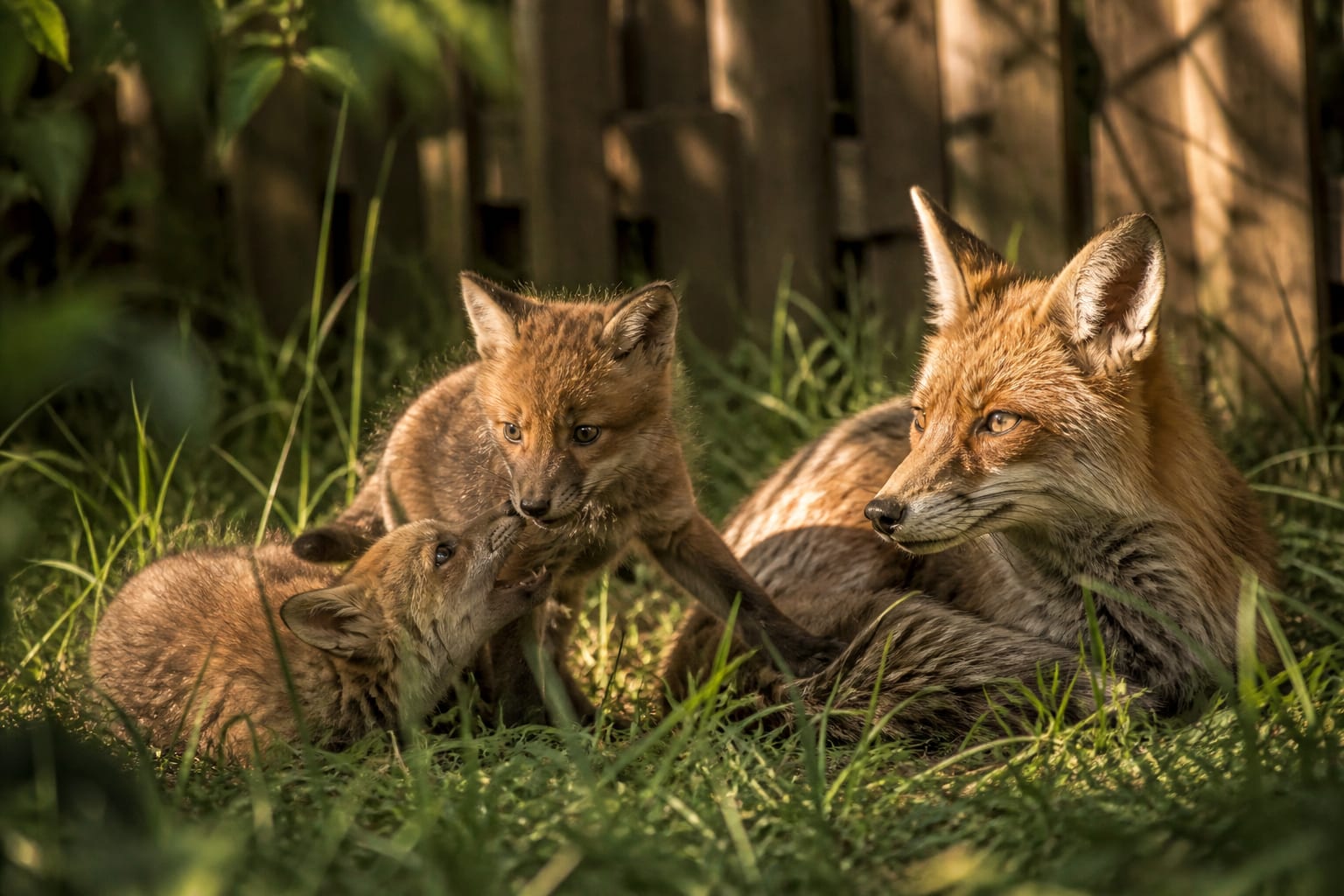
Hester Nwachukwu noticed the hole under her shed in late April and the kits in early May: four of them, sooty grey, tumbling out into the border of her vegetable garden at dusk while an adult red fox watched from beside the compost bin.
Her first call was to a pest removal company, which quoted her four hundred and eighty dollars. Her second call, on a neighbor's suggestion, was to the regional wildlife service, which told her to do nothing at all.
"That was very hard to accept for about ten days," she said.
The advice is standard and it rests on a fact about fox biology that most homeowners don't know: natal dens are temporary. A vixen chooses a den site in late winter, gives birth in March or April, and moves the family out as the kits become mobile — typically by mid-to-late summer, often earlier. Foxes don't overwinter in a suburban den site as a family unit. The kits disperse in autumn. The structure under the shed will be abandoned on a schedule that has nothing to do with human intervention.
Intervening, by contrast, tends to make things worse in specific and predictable ways. Trapping and relocating an adult fox in spring leaves dependent kits behind, who then die slowly under the shed. Relocation is also illegal in many jurisdictions and, where it's permitted, has poor outcomes: relocated adult foxes are dropped into occupied territory with no knowledge of local resources and frequently don't survive the season. Blocking the entrance while the family is inside is the worst option of all.
"The phrase we use is 'wait them out,'" said Regional Wildlife Officer Aurelio Banks. "Almost every fox-under-the-shed call in April resolves itself by August with no action. If you dig them out in May you have created a welfare disaster, a dead-animal-under-a-structure problem, and an empty den that a different fox will use next year, because the site was good enough that this one picked it."
What Banks does recommend is a short list of practical measures for the coexistence period. Keep small pets supervised outdoors, particularly rabbits and guinea pigs in hutches, which need a solid roof and a latch a fox cannot manipulate. Secure bins and stop feeding pets outside; a fox that finds a reliable food source becomes bolder, which is bad for the fox. Never feed them deliberately. And accept that things will disappear from the garden — foxes cache objects, and a den site's surroundings will accumulate a strange collection of shoes, garden gloves, and children's toys.
Nwachukwu's kits started ranging in June and were gone by the second week of July. She has not seen an adult in three weeks. Following Banks's advice, she waited a full two weeks after the last sighting, checked the den entrance for fresh tracks and prints in a smoothed patch of soil, and then filled the void and fitted a length of wire mesh in an L-shape extending outward from the shed's foundation — the exclusion method that actually works, done at the correct time of year.
Her own summary of the experience is the one wildlife officers wish they could put on a leaflet. "I had four fox cubs in my garden for nine weeks and it cost me one bag of gravel and some chicken wire," she said. "I did tell the man from the pest company. He was very nice about it."