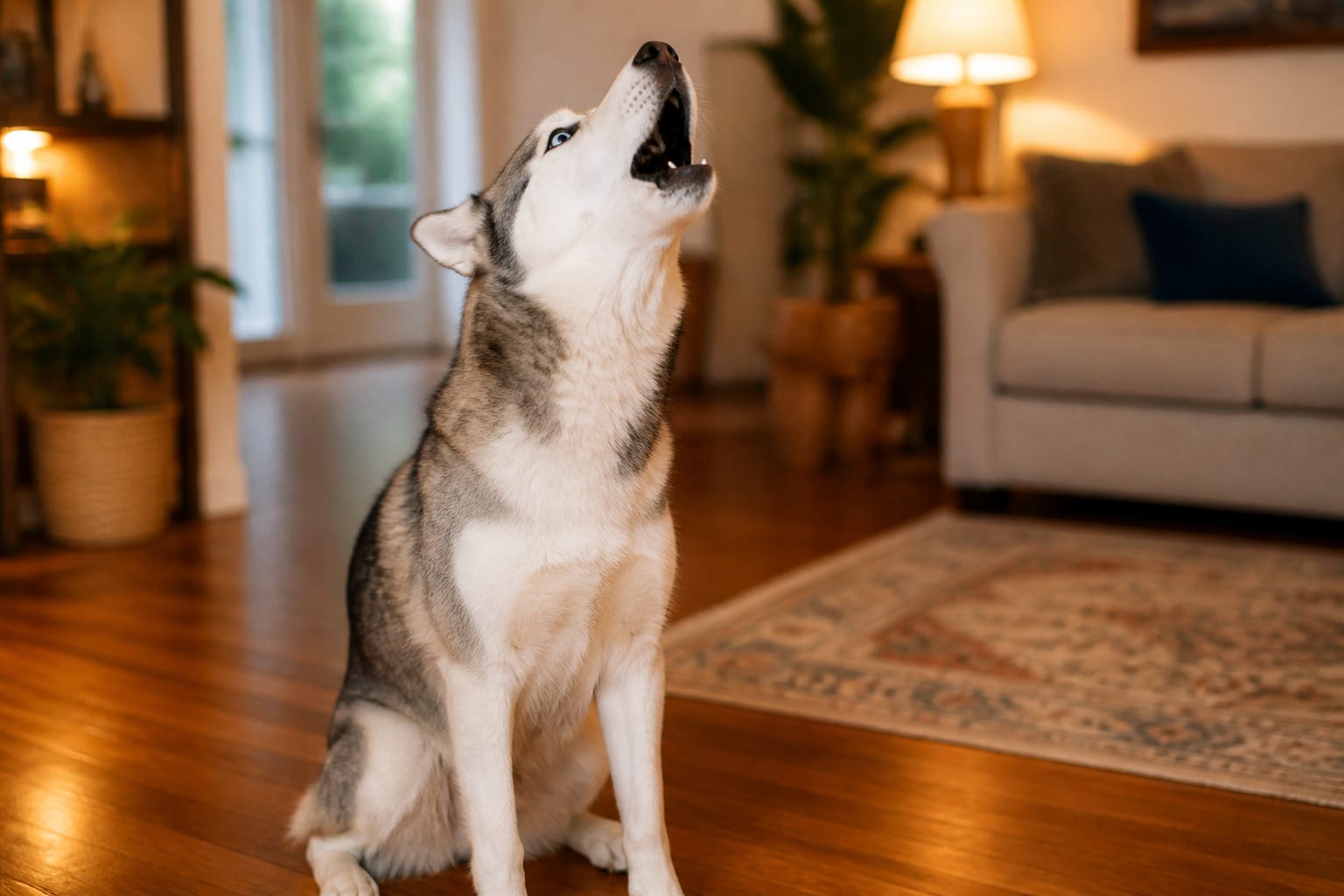
Every morning at roughly 6:50, a four-year-old Siberian husky named Bo plants himself in a hallway in Tacoma and produces a rising, warbling, unmistakably argumentative sound while his owner tries to leave for work. The clips have been viewed more than forty million times. In the comments, people transcribe them. "He said 'no.'" "He said 'five more minutes.'"
He didn't. But the reason the videos are so compelling isn't that people are being fooled — it's that they're picking up on something real.
Huskies are unusually vocal even among northern breeds, and their range of non-barking vocalizations is genuinely wide: the howl, the "woo," the yodel, the low grumble, and the escalating whine that people hear as complaint. Canine behavior researchers describe this as a byproduct of selective breeding for a working dog that had to communicate across distance in a team, combined with a general loosening of the wolf vocal repertoire in domestic dogs.
What Bo is doing is a learned exchange, and the mechanism is operant conditioning rather than language. He makes a sound. His owner responds — with words, with eye contact, with a delay in leaving. The response reinforces the sound. Over hundreds of mornings, the sound gets longer, more elaborate, and more precisely timed to the moment it works best, which is the moment the keys come off the hook.
"The dog has learned that this specific vocalization reliably produces a specific human behavior," said Dr. Ingrid Bexley, a comparative cognition researcher who studies canine communication. "That's not a small thing. It's a real communicative act. It just isn't syntax, and it isn't referential. He's not naming a thing or negotiating a term. He's operating a lever that happens to be shaped like a person."
Where this matters practically is when the "talking" isn't funny. The same escalating whine is one of the earliest signs of separation-related distress, and the two look nearly identical on video. Bexley's rule of thumb: watch what happens after the owner leaves. A dog performing a learned attention-getting routine typically settles within a few minutes. A dog in genuine distress escalates — pacing, drooling, scratching at the door, vocalizing for twenty minutes or more — and often has the household damage to show for it.
Bo's owner set up a camera for exactly this reason after a commenter raised it. Bo argues for ninety seconds, walks to the couch, and goes to sleep. That's a routine, not a panic.
The uncomfortable footnote to husky videos generally: they are extremely effective at selling the breed to people who should not have one. Northern breed rescues report predictable intake surges eighteen months after viral husky content, when the puppy that was charming at four months is a fifty-pound athlete who needs ninety minutes of daily exercise and can clear a four-foot fence. "Every rescue I know has a waiting list of huskies," said Marta Quinlan of a Pacific Northwest breed rescue. "They are wonderful. They are also loud, destructive when bored, and they will absolutely not come when called. The talking is real. Please watch the rest of the day too."